
Article Summary: Are you overwhelmed by the numerous technical specifications when choosing a home energy storage battery? Don't worry, this guide will help you become a "semi-expert" in interpreting battery specifications in just 5 minutes, using the most accessible method.
When choosing a home energy storage battery, product specifications like voltage (V), capacity (Ah), and kilowatt-hours (kWh) can be confusing. What do they actually mean? Which parameter directly determines how long your home appliances will last?
Today, Dawnice will help you quickly understand these key specifications so you can make a clear choice.

Core Concept: A Vivid Analogy
For a better understanding, let's use a plumbing system as an analogy for batteries:
Voltage - Think of it as "water pressure."
Water pressure determines the force and speed of water flow. Similarly, voltage represents the "thrust" of the current. The higher the voltage, the greater the ability to deliver electricity. Home energy storage batteries typically have a voltage of 48V or 51.2V (for example, Dawnice batteries use a standard 51.2V voltage, which effectively pairs with most home inverters).
Capacity - Think of it like the "thickness of a pipe" or the "size of a bucket."
The thicker the pipe, the more water it can flow through; the larger the bucket, the more water it can store. A battery's capacity (measured in Ah, ampere-hours) directly represents its ability to store electricity. For example, a 205Ah battery can store more energy than a 100Ah battery.
Energy - This is the true "water storage capacity."
The answer to your most pressing question—"How many kilowatt-hours of electricity are actually stored in my battery?"—is here. Energy is measured in kilowatt-hours, the same unit you'll see on your electricity bill.
It directly determines how long your home appliances last.
The Relationship: A Key Formula
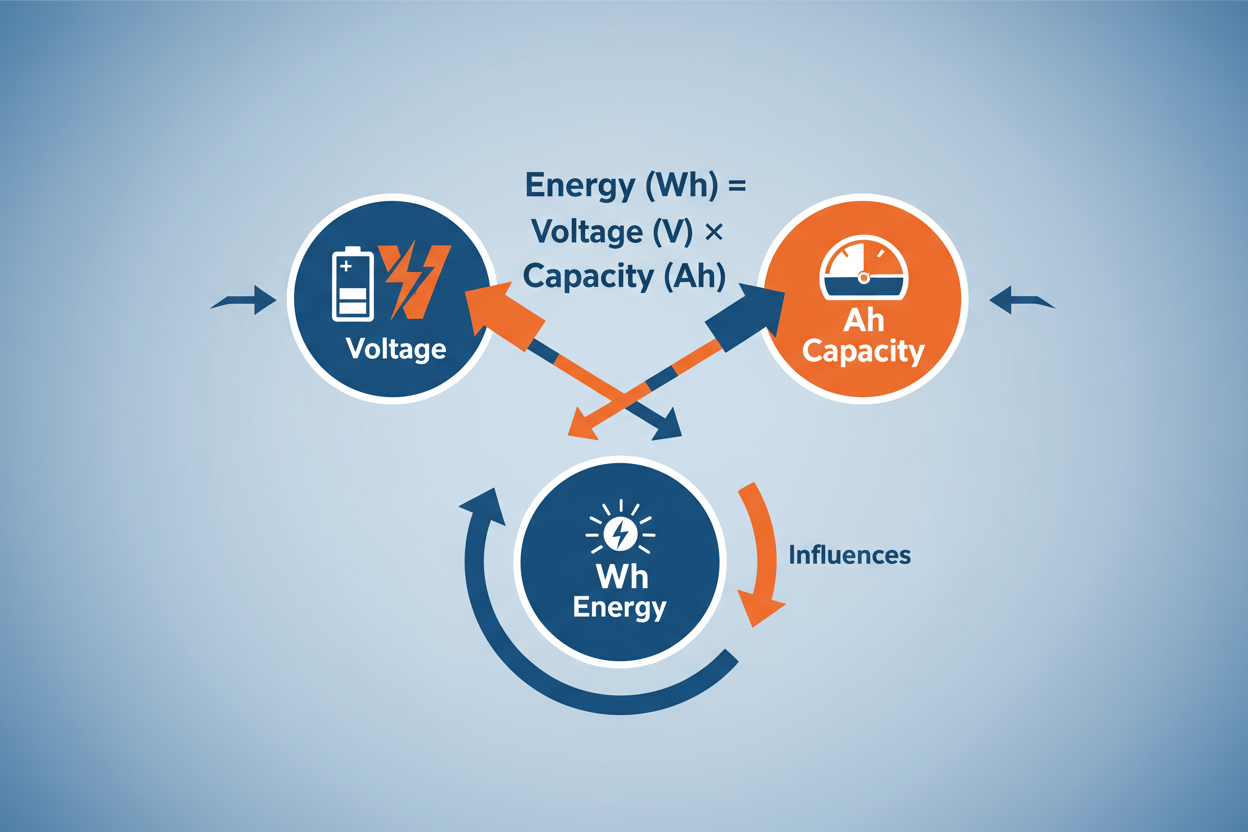
There's a very simple formula for these three:
Energy = Voltage × Capacity
How does this formula work? Let's look at a real-world example from a Dawnice product:
A Dawnice wall-mounted battery has specifications of 51.2V and 205Ah.
So its total energy capacity is: 51.2V × 205Ah = 10,496 Wh.
Converting to kilowatt-hours: 10,496 Wh ÷ 1000 = 10.496 kWh (approximately 10.5 kWh).
This means that this battery can theoretically power a 1-kilowatt appliance (such as a small air conditioner) for approximately 10.5 hours.
Tip: When comparing batteries, focus on the "kWh" number; it's the most direct indicator of a battery's "total fuel tank size."

Quick Q&A: Answering Your Practical Questions
Q1: Is a larger kWh (kilowatt-hour) better?
A: Not necessarily. It depends on your needs. A larger kWh means more energy storage and a higher price. You need to make a comprehensive calculation based on your household's daily electricity usage, the power of the appliances you want to back up, and the backup duration. Dawnice offers wall-mounted batteries with capacities ranging from 5kWh to 15kWh, as well as stackable rack batteries, to meet the individual needs of different households.
Q2: Why do some batteries have the same voltage but different kWh?
A: This is because the capacity (Ah) is different! Just like two pipes with the same water pressure, if one is thicker (higher Ah), its total water output (kWh) will naturally be greater.
Q3: Do these parameters affect battery lifespan?
A: Yes. High-quality battery cells and an advanced battery management system ensure that voltage and capacity remain stable over long-term use, reducing degradation. This is Dawnice's strength—we use top-quality power cells and an intelligent BMS to ensure that each battery maintains its nominal voltage and capacity over time, resulting in an exceptionally long lifespan of over 6,000 cycles.

Summary: How to understand battery specifications in three steps?
Next time you see battery specifications, just three steps:
Find "kWh": First, focus on it to understand the battery's total capacity.
Look for "V" and "Ah": Understand the battery's basic specifications and ensure compatibility with your inverter.
Trust the brand: Specifications are fundamental, but the underlying cell quality, manufacturing process, and BMS system are key to determining a battery's long-term reliability.
We hope this quick guide helps you clearly understand battery specifications and provides valuable reference for selecting the right home energy storage system.
Want to know how much energy storage system you need? Contact a Dawnice expert for a free, personalized design and calculation!

Leave a comment
This site is protected by hCaptcha and the hCaptcha Privacy Policy and Terms of Service apply.